SAE J2601 MC Formula-Based Fueling Protocol 09
9 Formula-Based Fueling Protocol
The MC Formula-based fueling protocol uses the station fuel delivery temperature and pressure, ambient temperature, CHSS capacity category, and CHSS initial pressure to calculate appropriate fueling parameters, in real-time for the duration of the fill. Modeling has been used to derive the parameters and coefficients utilized by the MC Formula-based protocol in order to optimize the fueling performance while ensuring that the process requirements of Section 6 are satisfied at all times. The key modeling assumptions are presented in Section 7, and details are provided in Appendix H.
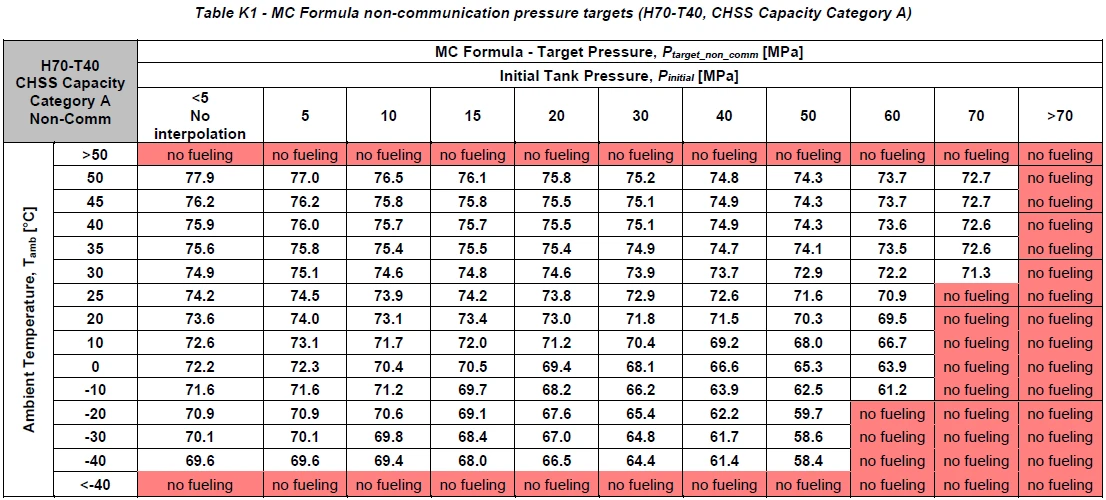
The station selects the appropriate parameters and coefficients based on the pressure class, the fuel delivery temperature category, the CHSS initial pressure, the CHSS capacity category, and the ambient temperature. These are used to calculate the pressure ramp rate (PRR) and target pressure, which are both updated periodically throughout the fill. There are two options provided for ending pressure control (i.e., determination of the target pressures): The MC Method, or ending pressure tables. Either option may be utilized. Appendix H provides a detailed explanation and rationale for each option.
For vehicles without communications, the station will stop the fill when the calculated non-communication target pressure is reached. For vehicles with communication, the station will stop the fill at a pressure corresponding to a CHSS SOC of 95 to 100%. The station may use vehicle data, including the communicated CHSS temperature, to calculate the communication target pressure corresponding to the target SOC. However, the MC Formula-based protocol also calculates a limit pressure, which takes precedence over the communication target pressure to ensure that the CHSS stays within its operational boundaries. SAE J2799 defines the fueling messages utilized for communications fills. Section 9.9 defines the use of the communications signals for the MC Formula-based protocol.
As with the table-based protocol, for any given station fuel delivery temperature, ambient temperature, and CHSS capacity category, the MC Formula-based protocol utilizes the same PRR for both H35 and H70 fueling; only the ending target pressures are different. This is done to address concerns about overheating if an H70 vehicle first fuels at an H35 dispenser and then immediately has an H70 fueling.
There are optional “cold dispenser” (CD) coefficients which can improve fueling times during back-to-back fueling events (only applicable to the H70 pressure class). They shall only be applied by a station that meets the CD criteria. See 9.10 for further details.
The MC Formula-based flow charts and control logic are detailed in Appendix I. The subroutines containing the equations and coefficients utilized are detailed in Appendix J.
9.1 General Hydrogen Fueling Requirements
Stations using the MC Formula-based protocol shall meet all of the requirements in Section 6.
9.1.1 Station Designators
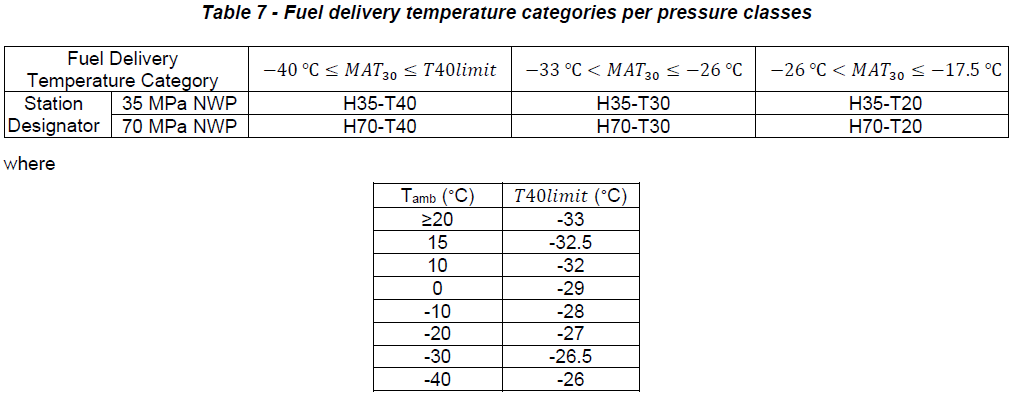
Table 7 illustrates the fuel delivery temperature categories per pressure class for the MC Formula-based protocol. A station is defined by the pressure class of fuel it delivers and its fuel delivery temperature capability. For example, the fuel delivery temperature category for the range from -40 to -33 °C is designated as T40. There are three fuel delivery temperature categories, designated by T40, T30, or T20. Although a station may offer more than one combination of pressure class and fuel delivery temperature category with multiple dispensers, it is recommended that stations utilize common fuel delivery temperature categories for all dispensers (see A.4 for rationale). A dispenser shall not fuel a vehicle of a lower pressure class.
MAT30 represents the mass average of Tfuel calculated starting after a total of 30 seconds of mass flow have elapsed. MAT30 is defined in more detail in H.2.4. The station designator for the MC Formula-based protocol is based on the capability of the station to achieve a value of MAT30 less than or equal to the upper boundary temperature of the fuel delivery temperature category by the end of the main fueling time.
In addition to being used as a station designator, the fuel delivery temperature category is also used to determine the ending pressure targets when ending pressure tables are used as the ending pressure control option. In this case, for the purpose of determining the correct pressure target to use, the fuel delivery temperature category is based on MATC instead of MAT30, where MATC represents the mass average of Tfuel used as the control input (see H.2.4 for an explanation of how MATC is determined). There may be fueling scenarios where MAT30 meets the intended fuel delivery temperature category for station designation, while MATC does not. This is more likely to occur when the initial SOC in the CHSS is high because MATC includes the warm gas from the cool-down period in its calculation whereas MAT30 does not.