
Data Center One Stop Solution
Data centers must be reimagined if they are to sustain the compute performance required to continue quantum leaps in discoveries and provide timely insights. To keep pace, GIGABYTE has researched and developed a new approach that goes beyond air cooled infrastructure, and into a method that dissipates heat better, Single-phase Immersion Cooling. This has proven to be more energy efficient and scalable for deployments across the globe, while being environmentally friendly and safe. For this new approach, GIGABYTE has created a one stop solution.
Charting a New Path with Advanced Cooling Reliability, availability, and serviceability are all traits found in the best data centers of today and tomorrow. As IT hardware and technology continue to improve, they are also making it tough for current data centers to be sustainable with the traditional fans, HVAC, and hot/cold aisles.
Why? A major reason - increase in rack power density. For each new generation of chips, the die size is shrunk while the number of transistors has increased, and this translates to higher performance, but also more heat. For instance, a GPU dense server can support CPUs and GPUS up to 300W TDP each component, but new generations of hardware are increasing the TDP by 25% or more, which is unsustainable in the same footprint. Consequently, servers are reaching thermal limitations. To maintain the same hardware density, a more efficient cooling approach is needed.
Data center architects realize this and quantify this efficiency using power usage effectiveness (PUE). PUE is a ratio that compares how much power enters the data center to the power delivered to IT equipment. Ideally, the PUE value would be 1.0; however, traditional air-cooled data centers achieve a PUE of ~1.65, which isn’t horrible, but it shows room for improvement. Single-phase immersion cooling can achieve a PUE in the ballpark of 1.02-1.03.
How it Works
Single-phase immersion cooling redefines the data center from how IT equipment is cooled to the reduction in the amount and complexity of the data center infrastructure. By submerging IT equipment into a dielectric liquid bath, heat is removed faster than air while no damage or degrading occurs to all components. The liquid coolant with a higher specific heat capacity than air can quickly remove the heat. The heat given off by CPUs, GPUs, and other components is transferred directly to the liquid or via a heatsink. The warm liquid is then pumped out by a coolant distribution unit (CDU) or dry cooler. In the CDU cases, a second transfer occurs as the heat is then transferred to facility water. The resulting cooled coolant is pumped back into the immersion tank while the warmed water continues on to a heat exchanger to be expelled. And the cycle continues. Also, as the name implies, the fluid in the immersion tank does not change state, so there is no evaporation or condensation occurring, which ensures operator safety and allows for easy servicing of the tank and IT equipment.
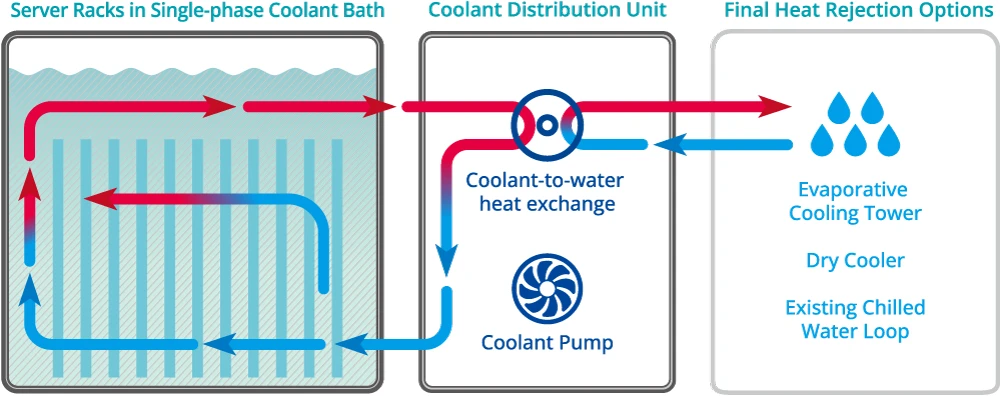
Heated coolant exits top of rack. Coolant returns to rack cooled at user-specified temperature.