SAE J2601 Table-Based Fueling Protocol 08
8 Table-Based Fueling Protocol
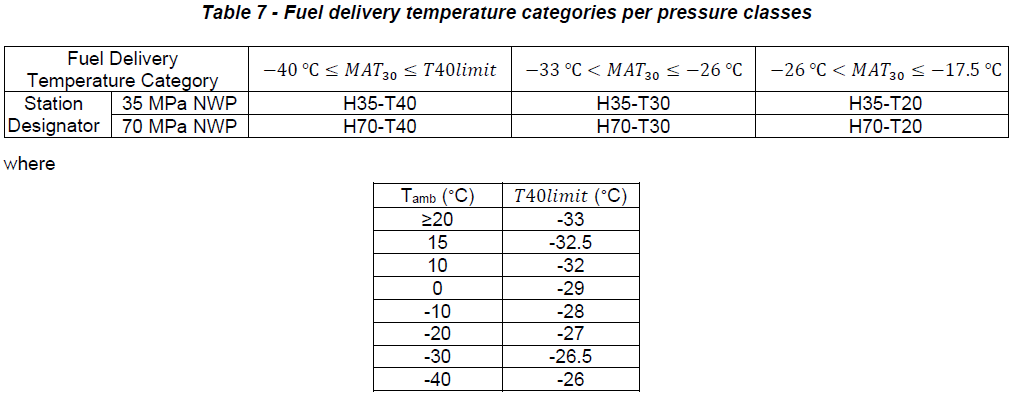
The table-based fueling protocol uses the station fuel delivery temperature, ambient temperature, CHSS capacity category, and CHSS initial pressure to select appropriate fueling parameters. Modeling has been used to develop a series of parameter look-up tables that optimize the fueling process while ensuring that the process requirements of Section 6 are satisfied at all times. Note that the key modeling assumptions are presented in Section 7, and details are provided in Appendix A.
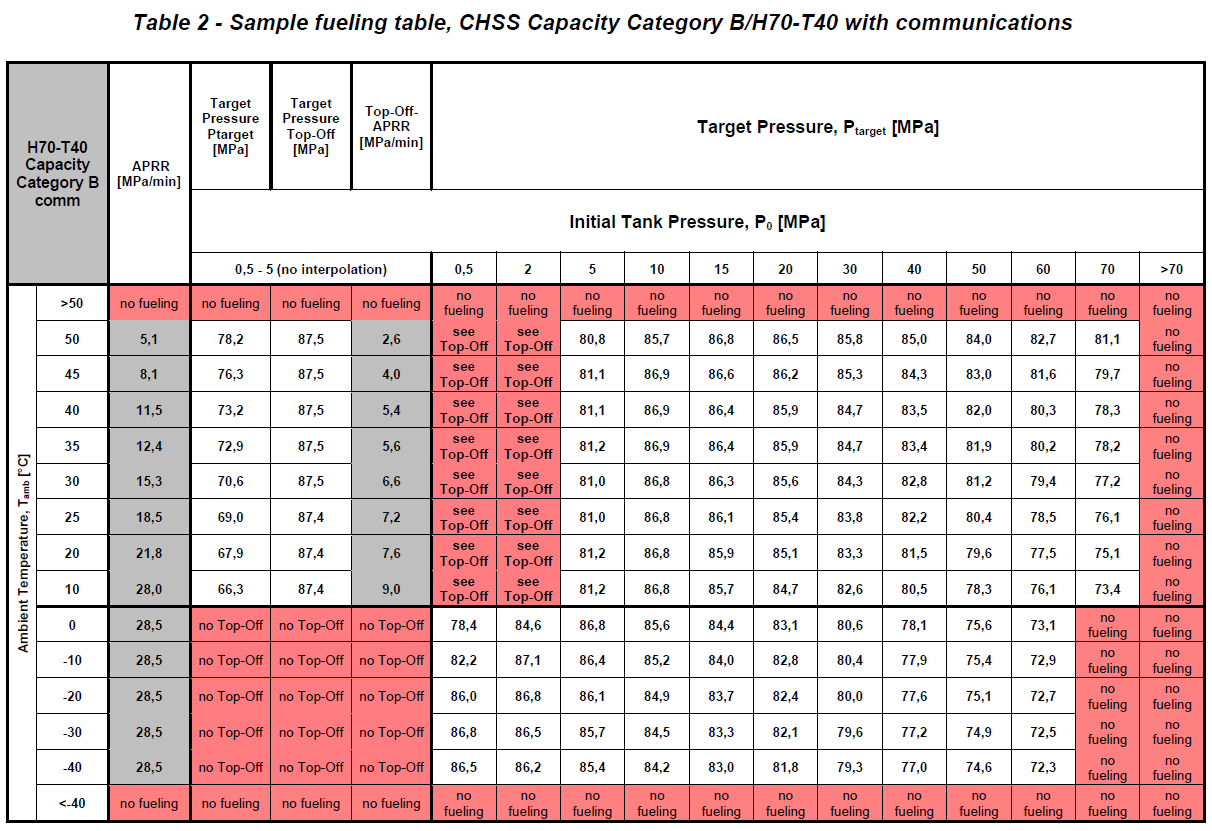
The station selects the correct look-up table based on fuel delivery temperature, CHSS capacity category, and the absence or presence of a communications signal from the vehicle. Once the proper table is selected, the station determines the specific fueling event parameters of average pressure ramp rate (APRR) and target pressure, based on ambient temperature and CHSS initial pressure. Detailed instructions on how to use the tables are provided in Appendix G.
For vehicles without communications, the station will fuel based on the look-up table APRR until the look-up table target pressure is reached. For vehicles with communication, the same APRR will be applied. The station may use vehicle data, including the communicated CHSS temperature, to calculate the SOC and fuel up to a pressure corresponding to an SOC of 95 to 100%. However, the communications fueling tables target pressure takes precedence over the SOC calculation to ensure that the CHSS stays within its operational boundaries.
A sample fueling table is shown in Table 2 and the complete set of standard fueling tables are included in Appendix D. It should also be noted that for any given station fuel delivery temperature, ambient temperature, and CHSS capacity category, the look-up tables provide the same APRR for both H35 and H70 fueling (for the same CHSS volume); only the ending target pressures are different. This was done to address concerns about overheating if an H70 vehicle first fuels at an H35 dispenser and then immediately has an H70 fueling.
The table-based fueling protocol also contains a “top-off” method for increasing the final SOC if the initial pressure is lower than 5 MPa.
There are optional “cold dispenser” (CD) tables which can improve fueling times (faster APRR) and may be implemented with a high utilization station (performing back-to-back fuelings). They may only be applied by a station that meets the CD criteria. See 8.12 for further details.