
Advances in hydrogen storage technologies
Abstract
https://doi.org/10.1016/j.jlp.2025.105561
Keywords
1. Introduction
The rupture of high-pressure hydrogen storage tanks must be excluded in any fire to eliminate hazards and associated risks from blast waves, fireballs, and projectiles at an incident scene. This would reduce the risk of hydrogen cars, trains, plains, and maritime vessels below that of fossil fuel vehicles. The use of an explosion-free in fire self-venting tank without thermally-activated pressure relief devices (TPRD) provides an unprecedented level of life safety, property, and environment protection.
The technology does not require TPRD which is known to be unreliable in localised fires. The European FireComp project suggests a 50% TPRD failure probability in localised fires. The explosions of CNG composite tanks equipped with TPRDs were reported in the USA. The catastrophic failure of a tank with TPRD is possible even in an engulfing fire, e.g., with conformable tanks. Indeed, the time to rupture such tanks with thinner walls (due to decreased diameter) in a fire is about 2 min. This is comparable to or even shorter than TPRD activation time in a fire (reported TPRD activation time is up to 3.5 min in an engulfing fire (Molkov et al., 2024). The innovative safety technology provides the microleaks-no-burst (μLNB) performance of Type IV tanks in a fire.
There is a range of fire scenarios. They extend from low-temperature smouldering fires, through the vehicle tyre fires and gasoline/diesel fires, to severe scenarios of impinging hydrogen jet fires, e.g. from nearby storage tanks. Self-venting tanks demonstrate their safe performance in fires of different intensities up to a specific heat release rate of HRR/A = 19.5 MW/m2, which any standard tank cannot withstand. Protection of tanks by intumescent pain is thought cannot protect them from rupture in such high-intensity hydrogen jet fire with momentum jet able to erode the paint.
The quantitative risk assessment (QRA) of scenarios with onboard tank rupture in a fire for hydrogen-powered vehicle incidents in the open atmosphere (Dadashzadeh et al., 2018) and in the tunnels (Kashkarov et al., 2022) was carried out. It is shown that the risk is unacceptably high for currently used standard tanks with the fire resistance ratings (FRR), i.e. time to rupture in a fire, of a few minutes, e.g., 4–6 min in typical for traffic incidents gasoline/diesel spill fires with specific heat release rate of HRR/A = 1–2 MW/m2. To achieve an acceptable level of risk the FRR of the compressed hydrogen storage system (CHSS) should exceed, for example, 50 min for London roads and 90 min for the Dublin tunnel, respectively. The situation in real-life conditions is aggravated by the fact that the GTR#13 fire test protocol (UN ECE, 2023) has reduced localised fire intensity of HRR/A = 0.3 MW/m2, and engulfing fire intensity of 0.7 MW/m2, i.e. below HRR/A = 1–2 MW/m2 characteristic for gasoline/diesel spill fires.
This paper summarises the results of research carried out in the last decade and the conclusions of a recent series of our three papers published in 2023–2024. The detailed concept and initial experimental validations of the technology for several carbon-carbon and carbon-glass double-composite wall μLNB tank prototypes of nominal working pressure NWP = 70 MPa and 7.5 L volume are described in our first paper (Molkov et al., 2023a). The second paper in a series (Molkov et al., 2024) is focused on experimental validation of μLNB tank performance in conditions of fire intervention. The third in a series paper (Molkov et al., 2023b) proved an extraordinary safety performance of self-venting (TPRD-less) tanks in extreme conditions of impinging hydrogen jet fire from 70 MPa storage with a specific heat release rate of HRR/A = 19.5 MW/m2.
2. The safety issue of the standard fire test for hydrogen storage in composite tanks
The FRR is defined as a time to rupture in a fire for a storage tank or CHSS with failed to be activated TPRD, e.g., in smouldering or localised fire, or TPRD blocked in incident from a fire. Fig. 1 shows the results of previous studies on the dependence of FRR as a function of HRR/A (thick blue strip).
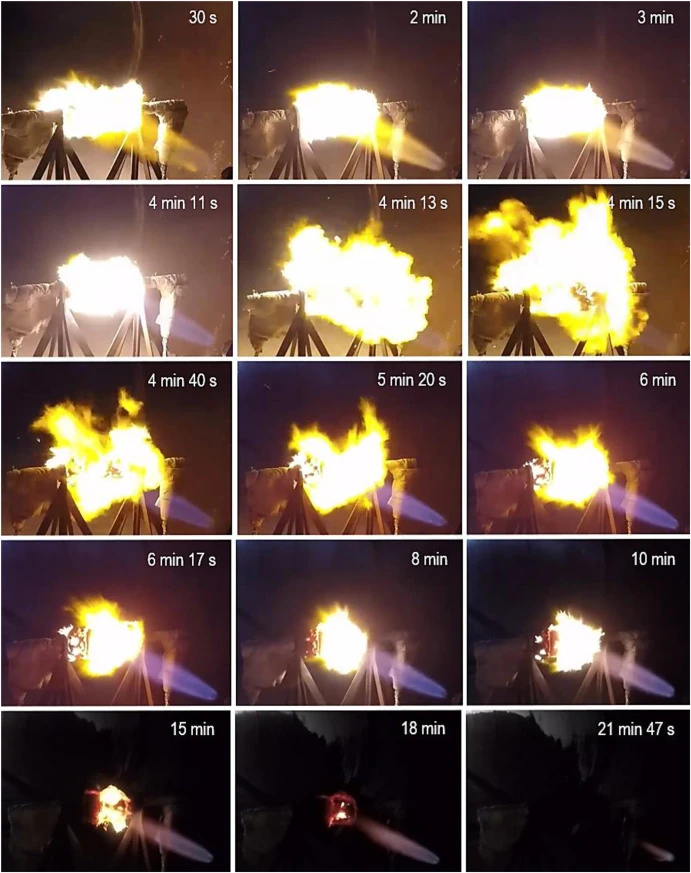
Fig. 8 presents snapshots of the extreme condition hydrogen impinging jet fire with HRR/A = 19.5 MW/m2. It is seen that at time 4 min 13 s when hydrogen starts to leak through microchannels of the composite wall (after melting the liner) the combustion intensities. This increase in heat release rate could, in principle, accelerate the melting of the resin of the composite inside the wall and decompose fibres on the tank's surface.