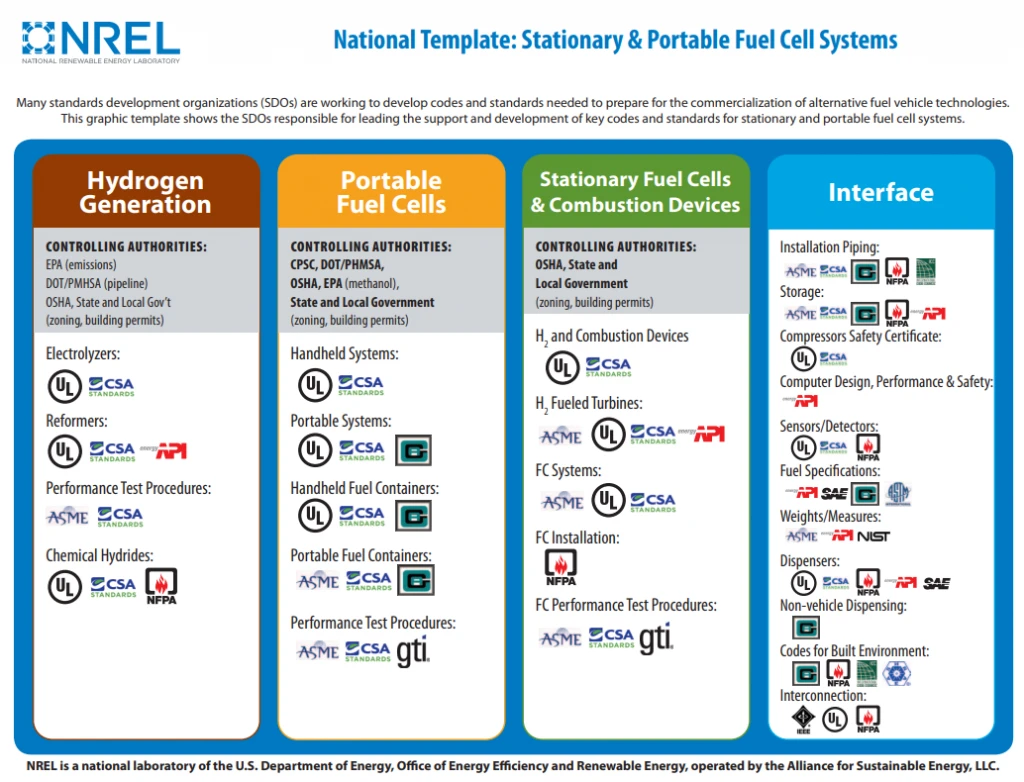
NREL National Template: Stationary & Portable Fuel Cell Systems
Codes and standards provide the information needed to safely build, maintain, and operate equipment, systems, and facilities. They help ensure uniformity of safety requirements and give local inspectors and safety officials the information they need to approve systems and installations.
Codes are requirements for the built environment – buildings and facilities. They are generally adopted by local jurisdictions, thereby achieving the force of law. Codes often refer to or invoke standards for the equipment used within the given built environment.
Standards are rules, guidelines, conditions, or characteristics for products or related processes, and generally apply to equipment or components. Although they’re not regulations, standards achieve a regulation-like status when they are referred to in codes or through other government regulations.
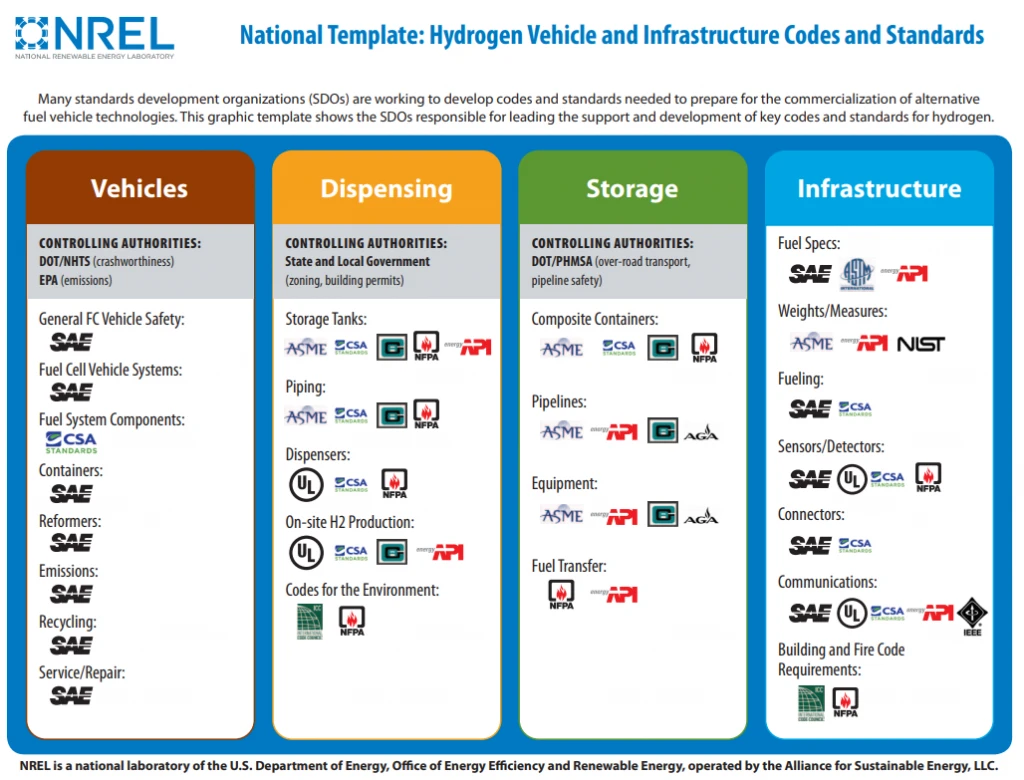
Although hydrogen has been used in industry for decades, its use as a fuel for vehicles or stationary power generation in consumer environments is relatively new. As such, hydrogen and fuel cell codes and standards are in various stages of development. Industry, manufacturers, the government, and other safety experts are working with codes and standards development organizations to prepare, review, and promulgate technically-sound codes and standards for hydrogen and fuel cell technologies and systems. Codes and standards are being adopted, revised, or developed for vehicles; fuel delivery and storage; fueling, service, and parking facilities; and vehicle fueling interfaces. Codes and standards are also being adopted, revised, or developed for stationary and portable fuel cells and interfaces, as well as hydrogen generators.
National Template
Template 1: stationary & Portable Fuel Cell Systems
Template 2: Hydrogen Vehicle and Infrastructure Codes & Standards