
Solar-powered hydrogen: exploring production, storage, and energy integration strategies
This review explores the advancements in solar technologies, encompassing production methods, storage systems, and their integration with renewable energy solutions. It examines the primary hydrogen production approaches, including thermochemical, photochemical, and biological methods. Thermochemical methods, though highly efficient, require advanced materials and complex reactor designs, while photochemical methods offer a simpler alternative but suffer from low conversion efficiencies. Biological hydrogen production presents a low-cost option but faces limitations in scalability and production rates. The review also highlights innovative hydrogen storage technologies, such as metal hydrides, metal-organic frameworks, and liquid organic hydrogen carriers, which address the intermittency of solar energy and offer scalable storage solutions. Additionally, the potential of hybrid energy systems that integrate solar hydrogen with photovoltaics, thermal energy systems, battery storage, and smart grids is emphasized. Despite technical and economic barriers, ongoing advancements in catalyst development, material optimization, and artificial intelligence-driven energy management systems are accelerating the adoption of solar hydrogen technologies. These innovations position solar hydrogen as a pivotal solution for achieving a sustainable and low-carbon energy future.
The global energy landscape is currently undergoing a significant transformation due to the increasing demand for sustainable and environmentally friendly energy solutions, which is driven by several factors, including the growing global population, rapid industrialization, and the urgent need to mitigate the effects of climate change. Traditional energy sources, such as fossil fuels, contribute heavily to greenhouse gas emissions and are limited in supply, making them unsustainable in the long term. Wind, solar, and hydropower offer promising alternatives that can significantly reduce the environmental impact of energy production, in which solar energy stands out due to its abundance and geographical flexibility, which can be captured in almost any location on Earth , making it a flexible and widely usable option for energy generation. However, solar energy is not always available because it depends on daylight and weather conditions, which creates a significant challenge, requiring the development of efficient energy storage systems to ensure a consistent and reliable energy supply. Solar energy can be captured and converted into various forms, including electrical energy via photovoltaics (PVs), thermal energy through solar heating systems, and chemical energy in the form of solar fuels, in which the conversion of solar energy into chemical energy represents a promising strategy for overcoming the challenges of intermittency and storage . Solar fuels, such as hydrogen, store solar energy in chemical bonds that can be released on demand, providing a flexible and long-term energy storage solution. As a clean energy carrier, hydrogen can be used in fuel cells to produce electricity with water as the only byproduct, making it an attractive option for reducing carbon emissions in sectors such as transportation, industry, and power generation. Furthermore, hydrogen can be stored in compressed, liquefied, or chemically bonded forms, providing a versatile means of energy storage and transport. One of the most promising avenues for producing hydrogen sustainably is through solar hydrogen production, which directly or indirectly uses solar energy to split water into hydrogen and oxygen. Unlike traditional hydrogen production methods that depend on fossil fuels and produce significant carbon emissions, solar hydrogen production is environmentally friendly and uses an unlimited energy source. Solar hydrogen production can be achieved through several processes, including thermochemical water splitting, photochemical reactions, and biological processes. In addition, hydrogen can serve as both a fuel and an energy storage medium, and its ability to be stored for long periods enables it to bridge the gap between solar energy availability and demand, effectively addressing the intermittency of solar power, which makes it a valuable resource not only in energy production but also in stabilizing energy grids and providing backup power in off-grid applications. Despite the significant promise of solar hydrogen, there are still numerous technical and economic barriers that must be overcome before it can be deployed at scale. Challenges such as low conversion efficiencies, high production costs, and the need for advanced materials in catalytic processes are currently limiting the widespread adoption of solar hydrogen technologies. However, ongoing research in areas such as catalyst development , reactor design, and integration with renewable energy systems is steadily improving the viability of these technologies. This review will provide a comprehensive overview of the current state of solar hydrogen production, storage technologies, and systems integration, with a focus on the major approaches including thermochemical, photochemical, and biological methods as illustrated in Fig. 1, which presents a graphical abstract of solar-powered hydrogen technologies. By examining the underlying principles, recent advancements, and technical challenges associated with each method, the aim of this study is to highlight the potential of solar hydrogen as a key component in the future of renewable energy storage.
Solar hydrogen production technologies
Solar energy can be converted into hydrogen through three primary methods (as shown in Fig. 2): thermochemical, photochemical, and biological processes. Thermochemical production involves high-temperature reactions, often using metal oxides, to split water into hydrogen and oxygen, typically driven by concentrated solar power (CSP). Photochemical methods use solar energy to directly drive water-splitting reactions via photocatalysts, offering a potentially simpler and lower-cost route to hydrogen. Lastly, biological processes utilize microorganisms, such as algae or bacteria, to produce hydrogen from sunlight through their natural metabolic activities.
Thermochemical hydrogen production
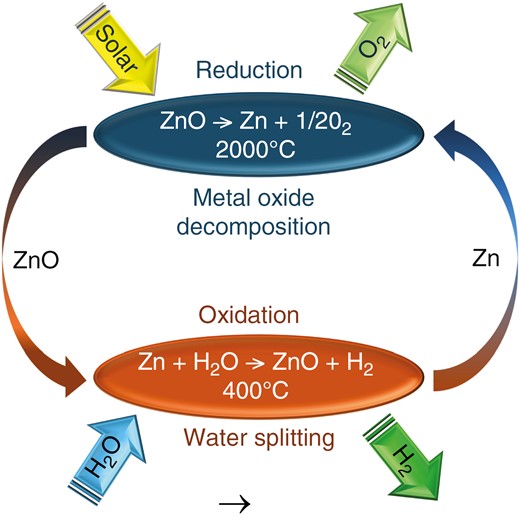
Thermochemical hydrogen production is a promising method for typically utilizing CSP to drive high-temperature chemical reactions, splitting water into hydrogen and oxygen, which utilizes solar energy to heat reactants to temperatures that facilitate water decomposition, typically involving such as sulfur-iodine (S-I) , hybrid sulfur (HyS) , calcium-bromine , and metal oxide reduction-oxidation (redox) cycles . Among these, metal oxide cycles have gained significant attention due to their high efficiency, scalability, and relative simplicity. These cycles, such as ZnO/Zn, CeO2/Ce2O3, and Fe3O4/FeO, operate through a straightforward two-step redox mechanism that effectively converts solar thermal energy into chemical energy . Unlike the S-I and HyS cycles, which involve corrosive chemicals and complex multi-step reactions, metal oxide cycles rely on widely available and cost-effective materials like ZnO and CeO2, making them practical for industrial-scale applications [24]. In comparison, methods like S-I and HyS, while capable of high yields, involve greater operational complexity and higher costs, limiting their scalability [17]. Metal oxide cycles thus strike an ideal balance between efficiency, simplicity, and scalability, positioning them as a leading candidate for sustainable and large-scale solar hydrogen production. Table 1 provides a comprehensive overview of thermochemical hydrogen production methods, summarizing their efficiency, production rates, material durability, potential advantages, and associated challenges.
Discussion and future perspectives
The development of solar hydrogen production and storage technologies presents a transformative opportunity to advance sustainable energy systems, yet their implementation faces significant technical and economic hurdles. Thermochemical, photochemical, and biological methods each offer distinct pathways for hydrogen production, but their scalability and viability remain subjects of ongoing debate, emphasizing the need for critical analysis and innovation.
Thermochemical hydrogen production, particularly through integration with CSP systems, has shown considerable promise due to its high efficiency and compatibility with advanced materials such as metal oxides in redox cycles. However, the reliance on extreme operating temperatures (>1500°C) presents challenges, including material degradation, complex reactor design, and high operational costs. While advocates highlight the potential of high-temperature materials and advanced thermal energy storage systems to mitigate these issues, concerns persist regarding the energy losses during heat transfer and the scalability of CSP infrastructure. Continued research into novel reactor designs and improved thermal coupling strategies is necessary to address these limitations effectively.
Photochemical hydrogen production provides a more direct and potentially cost-effective approach by harnessing sunlight to drive water-splitting reactions. Yet, the low solar-to-hydrogen conversion efficiencies of current photocatalysts represent a significant barrier. Advances in bandgap engineering, heterostructures, and plasmonic enhancements are promising, but questions remain about the long-term durability and stability of materials such as perovskites MOFs. While these materials show enhanced light absorption and charge separation capabilities, their environmental sensitivity, particularly to moisture, raises concerns about their practicality. Addressing these challenges will require robust testing under real-world conditions and the development of stable material configurations.
Biological hydrogen production is often lauded for its low-temperature processes and alignment with natural metabolic pathways, yet it struggles with slow production rates and the oxygen sensitivity of key enzymes such as hydrogenase. Innovations in metabolic engineering, including the development of oxygen-tolerant enzymes and synthetic biology techniques, have yielded promising results in laboratory settings. However, scaling these systems introduces additional complexities, such as nutrient management and efficient bioreactor design. Opposing perspectives on the feasibility of large-scale deployment highlight the necessity for pilot-scale projects that bridge the gap between experimental advancements and industrial applications.
Hydrogen storage technologies remain a pivotal factor in enabling the widespread adoption of solar hydrogen systems. Conventional methods like compressed gas and liquefied hydrogen are mature but constrained by low volumetric densities and energy-intensive processes. Solid-state storage materials, including metal hydrides and MOFs, offer safer and higher-density storage solutions, though they are challenged by slow hydrogen release kinetics, high material costs, and degradation during repeated cycling. Advocates for these technologies point to advancements in nanostructuring and catalytic enhancements as pathways to improve performance, while critics emphasize the need for comprehensive lifecycle analyses to ensure their cost-effectiveness and scalability.
Integrating solar hydrogen systems into renewable energy grids adds another layer of complexity. Hybrid systems that combine PV or CSP technologies with hydrogen production offer flexibility but require sophisticated energy management to balance supply and demand. While some view the energy losses in electrolyzers and fuel cells as a barrier to efficiency, advancements in smart grids and AI-driven optimization are being explored to dynamically allocate energy and enhance grid stability. However, the limited number of large-scale implementations highlights the uncertainty surrounding the scalability and reliability of such systems, underscoring the importance of demonstration projects to validate their potential.
The successful adoption of solar hydrogen technologies will depend not only on technological breakthroughs but also on supportive policy measures and economic incentives. Subsidies, tax credits, and carbon pricing mechanisms are essential to close the cost gap between renewable and fossil fuel-derived hydrogen. Furthermore, the establishment of international hydrogen certification schemes will promote transparency and distinguish sustainable hydrogen in global markets.
In conclusion, while solar hydrogen technologies hold significant potential for decarbonization and energy storage, addressing their technical, economic, and policy-related challenges will require a balanced approach that incorporates diverse perspectives. By fostering collaboration across research, industry, and government sectors, and prioritizing real-world testing, these technologies can evolve into a cornerstone of the global energy transition, supporting applications ranging from grid stabilization to industrial processes and sustainable transportation.