Why Use Thermoplastic Hose?
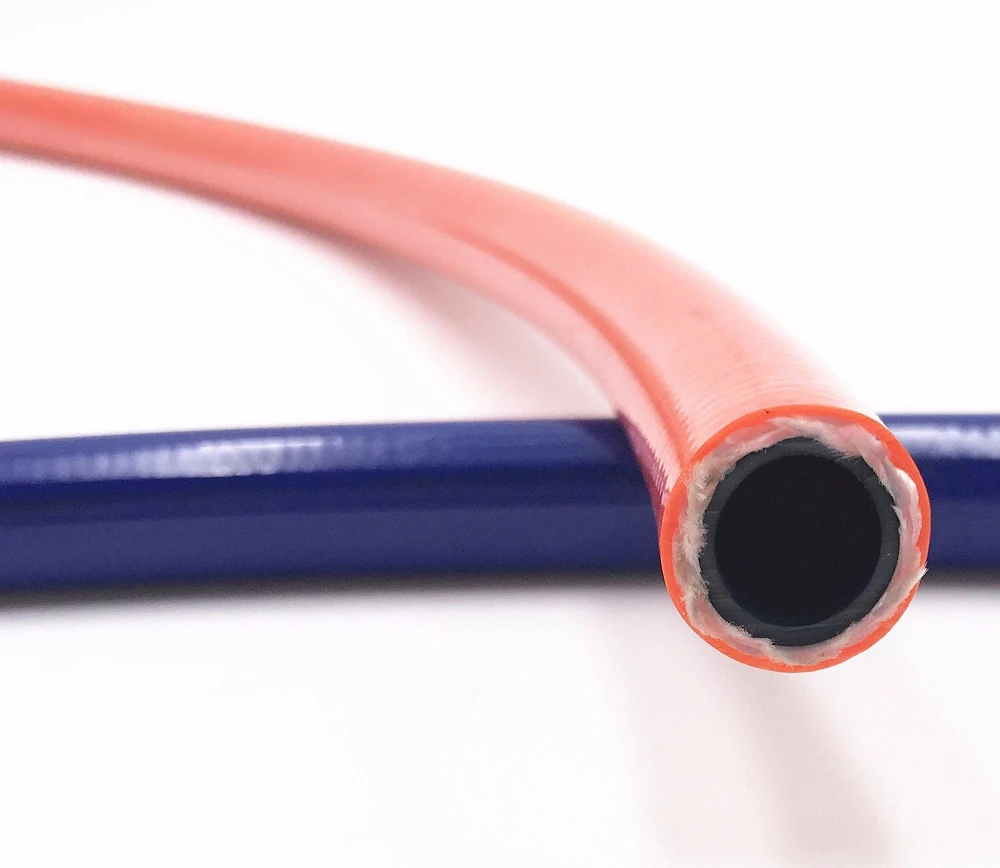
A thermoplastic hose is a flexible tubing made from thermoplastic polymers that can be repeatedly softened by heat and hardened by cooling, offering durability, chemical resistance, and electrical non‑conductivity in many applications.
Thermoplastic Material
A thermoplastic, or thermosoftening plastic, is any plastic polymer material that becomes pliable or moldable at a certain elevated temperature and solidifies upon cooling.
Most thermoplastics have a high molecular weight. The polymer chains associate by intermolecular forces, which weaken rapidly with increased temperature, yielding a viscous liquid. In this state, thermoplastics may be reshaped, and are typically used to produce parts by various polymer processing techniques such as injection molding, compression molding, calendering, and extrusion.[3][4] Thermoplastics differ from thermosetting polymers (or "thermosets"), which form irreversible chemical bonds during the curing process. Thermosets do not melt when heated, but typically decompose and do not reform upon cooling.
Stress-strain graph of a thermoplastic material
Above its glass transition temperature and below its melting point, the physical properties of a thermoplastic change drastically without an associated phase change. Some thermoplastics do not fully crystallize below the glass transition temperature, retaining some or all of their amorphous characteristics. Amorphous and semi-amorphous plastics are used when high optical clarity is necessary, as light is scattered strongly by crystallites larger than its wavelength. Amorphous and semi-amorphous plastics are less resistant to chemical attack and environmental stress cracking because they lack a crystalline structure.
Brittleness can be decreased with the addition of plasticizers, which increases the mobility of amorphous chain segments to effectively lower the glass transition temperature. Modification of the polymer through copolymerization or through the addition of non-reactive side chains to monomers before polymerization can also lower it. Before these techniques were employed, plastic automobile parts would often crack when exposed to cold temperatures. These are linear or slightly branched long chain molecules capable of repeatedly softening on heating and hardening on cooling.
Thermoplastic Hose Features and Benefits
1. Abrasion
Outer covers to withstand extreme wear
Superior cut resistance and extended service life
TOUGHJACKET covers offer 650x the resistance of standard rubbe
2. Compact Outter Diameter
Space saving due to very small diameters
More hoses can be installed in the same situation
Quicker routing through tight spaces
3. Small Inner Diameter
Only thermoplastic materials allow small I.D.s down to below 2mm
Space saving
Technical solutions otherwise often not possible
4. Low Weight
Major weight savings
Energy savings as less mass needs to be moved
Reduced operator fatigue from handling hoses
5. Customization | Performing
Multiple colors
Bundles
Customer specific designs
Preformed hoses maintain their full performance
Formed hoses combine the advantages of bent metal pipe with the flexibility of hose
Reduced weight, noise and vibration compared to bent metal pipe and rubber
6. Cleanliness
Highly limited gas egression
Reduced ingression reduces risk of media contamination
7. Permeation Resistance
Low gas permeation
Reduced ingression reduces risk of media contamination
8. Customization
Multiple colors
Multiple lines
Bundles
Customer specific designs and shapes
9. Long Lengths
Continuous lengths up to 10,000+ feet
Less joints & fittings reduces potential leak points and weight
Easy winching and handling offer fast deployment of long length
10. Highest Pressure
Up to 4,000 bar working pressure
Highest technical standards and production controls assure safety
11. Fast Response
Fast response times over long lengths
Faster valve actuation
Reduced volumetric expansion
Thermoplastic General Application
Standard hydraulics
Oil and gas
Mini hydraulics
Industrial hydraulics
Mobile hydraulics
Chemical industry
Process engineering
Industrial gases
Alternative fuels
Automotive and truck industry
Boats and yachts
Pneumatics
Wind power
Life Science
Media Transfer versus Hydraulics