SAE J2601 Appendix H MC Formula-based Protocol Rationale & Dev. Process 18
Appendix H - MC Formula-based Protocol Rationale and Development Process
H.1 INTRODUCTION
The MC Formula-based fueling protocol described in Section 9 is an adaptive fueling protocol, which dynamically adjusts the rate of change in dispenser pressure and the end of fill target pressure, based on inputs which are measured by the dispenser, namely the ambient temperature, the initial gas pressure in the CHSS, mass flow and the measured gas pressure and temperature at the dispenser outlet. Like the table-based protocol described in Section 8, the MC Formula-based protocol utilizes initial conditions measured by the dispenser to calculate the appropriate pressure ramp rate and ending pressure target. However, unlike the table-based protocol which utilizes these parameters throughout the fill, the MC Formula-based protocol utilizes these fixed parameters only for the first 30 seconds of the fill, after which they are calculated and updated at a frequency of once every second for the remainder of the fill.
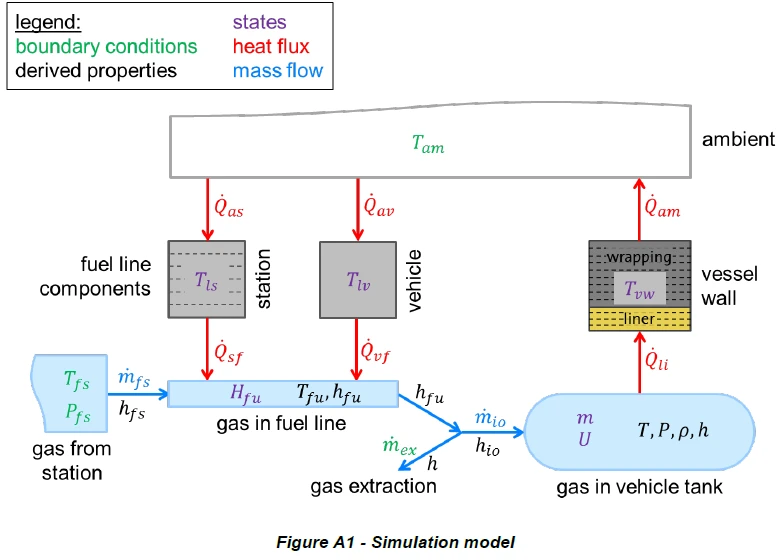
The MC Formula-based protocol follows the operating boundaries (Section 5), process requirements (Section 6), and key modeling assumptions (Section 7). Similar to the table-based protocol, the MC Formula-based protocol was developed using computer modeling. The same fueling model described in A.1 was used in deriving the coefficients and parameters for the equations which dictate the overall fueling time, the instantaneous pressure ramp rate and the ending pressure target. Likewise, the same general assumptions (A.2), and hot case and cold case assumptions (A.3) are utilized in the MC Formula-based protocol.
The structure of the MC Formula-based protocol is divided into two parts - pressure ramp rate control, and ending pressure control. The pressure ramp rate control dictates the instantaneous pressure ramp rate (PRR) and is based off the hot case assumptions. It is based on a regression equation which defines the amount of time (tfinal) required to fill from the minimum pressure (Pmin) to the final pressure (Pfinal) without exceeding the gas temperature limit of 85 °C within the hot case CHSS. The regression equation for tfinal is a cubic polynomial based on the mass average of the fuel delivery temperature (Tfuel). The coefficients for this cubic equation are calculated for discrete ambient temperatures, resulting in a table of coefficients, which are looked up. tfinal is the control input parameter to a pressure ramp rate equation, which dictates the instantaneous pressure ramp rate and the control pressure the dispenser should follow.
The ending pressure control is calculated separately from the pressure ramp rate control and dictates the station pressure at which the fill should end. The ending pressure control utilizes the cold case assumptions, just like the table-based protocol. There are two options for ending pressure control: the MC Method or ending pressure tables.
The first option is based on a methodology called the MC Method which calculates the end of fill gas temperature within the CHSS based on the initial CHSS pressure and CHSS gas temperature in combination with the measured enthalpy of the dispenser and elapsed fueling time. Because of the cold case assumptions, this end of fill gas temperature is the coldest expected temperature. The end of fill gas temperature is then used to calculate a pressure target which ensures the fill stops at the appropriate density. The MC Method is a lumped heat capacity model where MC represents the combined heat mass of the control volume and is denoted in units of kJ/K. The M and the C in the name are derived from the concept of mass times specific heat capacity.
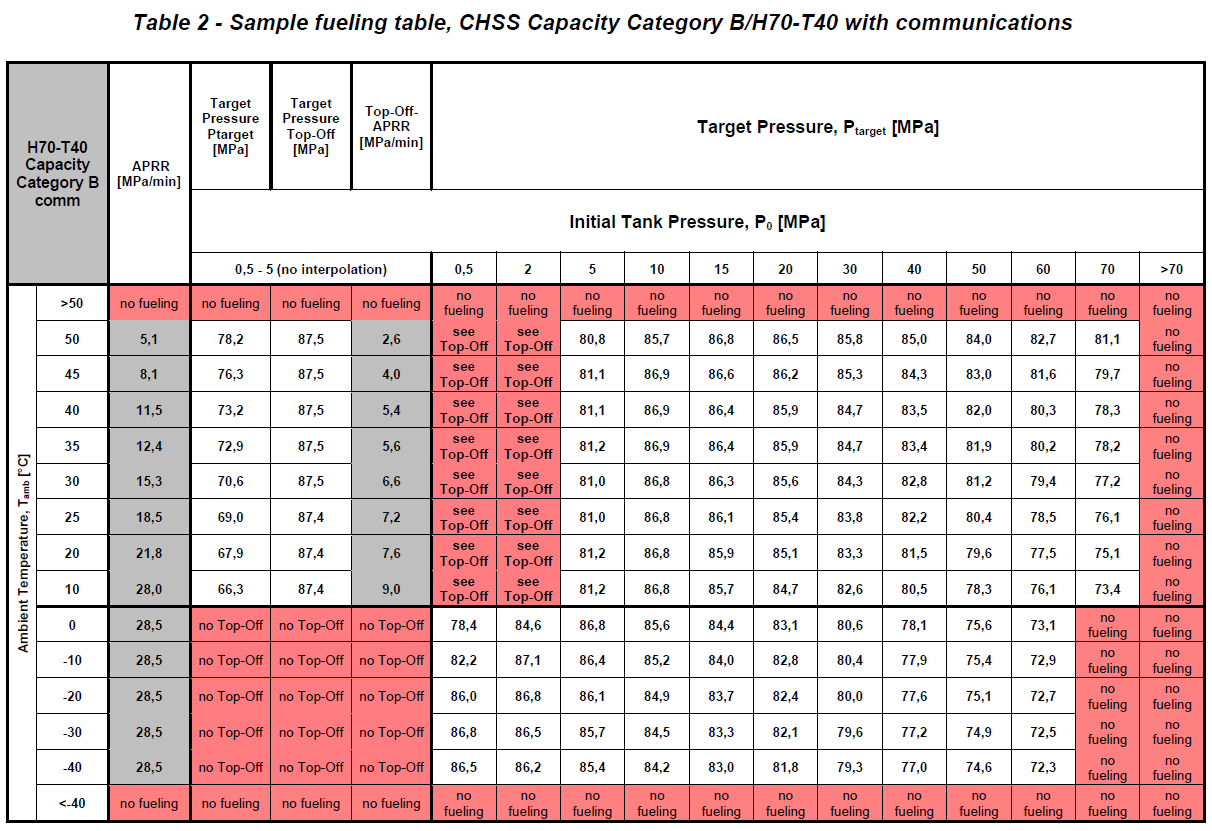
The second option for ending pressure control is a set of lookup tables providing non-communication fueling pressure targets, and communication fueling pressure limits. These lookup tables function the same way as those utilized in the table-based protocol. However, the determination of which ending pressure table to be used is based on the mass average of the fuel delivery temperature, which is updated continuously throughout the fill.
The dispenser manufacturer should choose one or the other of these two ending pressure control options.
H.2 PRESSURE RAMP RATE CONTROL
Sections A.1 through A.3 should be referenced for an understanding of the computer model, assumptions and boundary conditions utilized in the derivation of the tfinal cubic equation coefficients. This section will describe the simulations conducted, the derivation of the coefficients, and how the coefficients are utilized in the MC Formula-based protocol for pressure ramp rate control.
H.2.1 Constant Pressure Ramp Rate Simulations
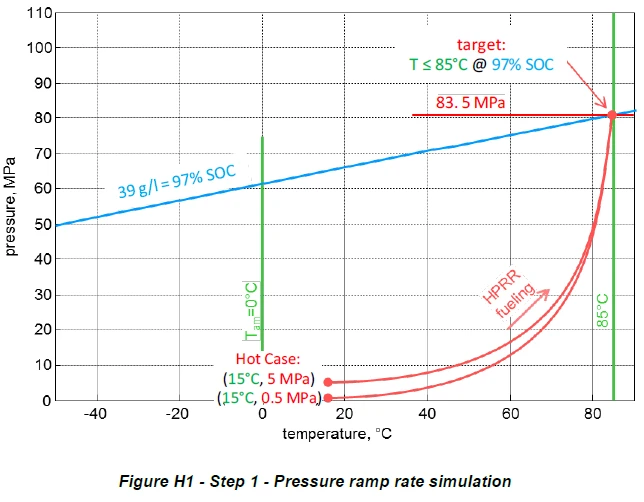
The tfinal cubic equation coefficients are derived from a series of fueling simulations conducted at a constant pressure ramp rate. Pressure ramp rates are generally designed to avoid overheating a CHSS under worst-case conditions. These worst-case conditions for overheating are collected in the set of hot case assumptions. The simulation runs for determining the highest pressure ramp rate that will still not overheat the CHSS therefore use hot case parameters, initial and boundary conditions. Figure H1 illustrates a H70 fueling simulation in a pressure-temperature state diagram for an exemplary ambient temperature 0 °C. The CHSS temperature is initialized at the hot soak temperature 15 °C. During fueling, there is a rapid temperature increase inside the CHSS at the beginning; later the slope of the fueling curve becomes steeper because the pressure increase dominates over the temperature increase. The simulation stops whenever the CHSS is “full” (97% SOC) or reaches the upper temperature limit 85 °C. During the simulation, the pressure ramp rate at the station is held constant. The procedure of computing the optimal pressure ramp rate that fulfills both SOC and temperature conditions at the end is an iterative process. It requires a number of fueling simulations with different pressure ramp rates to find the optimal ramp rate. There is a third condition to be fulfilled by the optimal ramp rate: the peak flow rate which may occur at any time during the fueling simulation shall not exceed 60 g/s. This is illustrated in Figure H2. If it does, the pressure ramp rate must be decreased, automatically decreasing the peak flow rate. Therefore, the resulting pressure ramp rate will generally satisfy only one of the conditions: (a) the final gas temperature reaches 85 °C (this typically occurs for high ambient temperatures and small CHSSs), or (b) the peak flow rate reaches 60 g/s (this typically occurs for cold ambient conditions and large CHSSs). The final SOC however is always 97%. Note that the SOC target 97% is a tradeoff to increase the resulting pressure ramp rate (and decrease the fueling time).
A second tradeoff was made in order to generate higher pressure ramp rates; two sets of coefficients were derived: one with an initial CHSS pressure of 5 MPa, and another with an initial CHSS pressure of 0.5 MPa. The end of fill gas temperature is strongly a function of the initial gas pressure; higher initial pressures result in lower ending gas temperatures. Thus, the coefficients derived for an initial CHSS pressure of 5 MPa result in a reduction of the fueling time over those derived with an initial CHSS pressure of 0.5 MPa. The justification for utilizing two sets of coefficients based on the initial CHSS pressure is that the majority of fills are initiated with an initial CHSS pressure higher than 5 MPa. For the small fraction of fills initiated at an initial CHSS pressure below 5 MPa, to avoid overheating, a separate set of coefficients are utilized. This approach is similar to that employed for the table-based protocol (see A.4) where, instead of utilizing two sets of APRRs, a pressure target in combination with a significantly reduced top-off pressure ramp rate is utilized. The top-off pressure ramp rate approach could not be utilized with the MC Formula-based protocol because it is based on a known APRR, whereas the PRR for the MC Formula-based protocol is variable. The end result is essentially the same, however, in that the overall fueling time is reduced for fills initiated with a CHSS pressure below 5 MPa.