
CODE | Dual Shift Register 8-Bit Binary Counter - Arduino Project 018
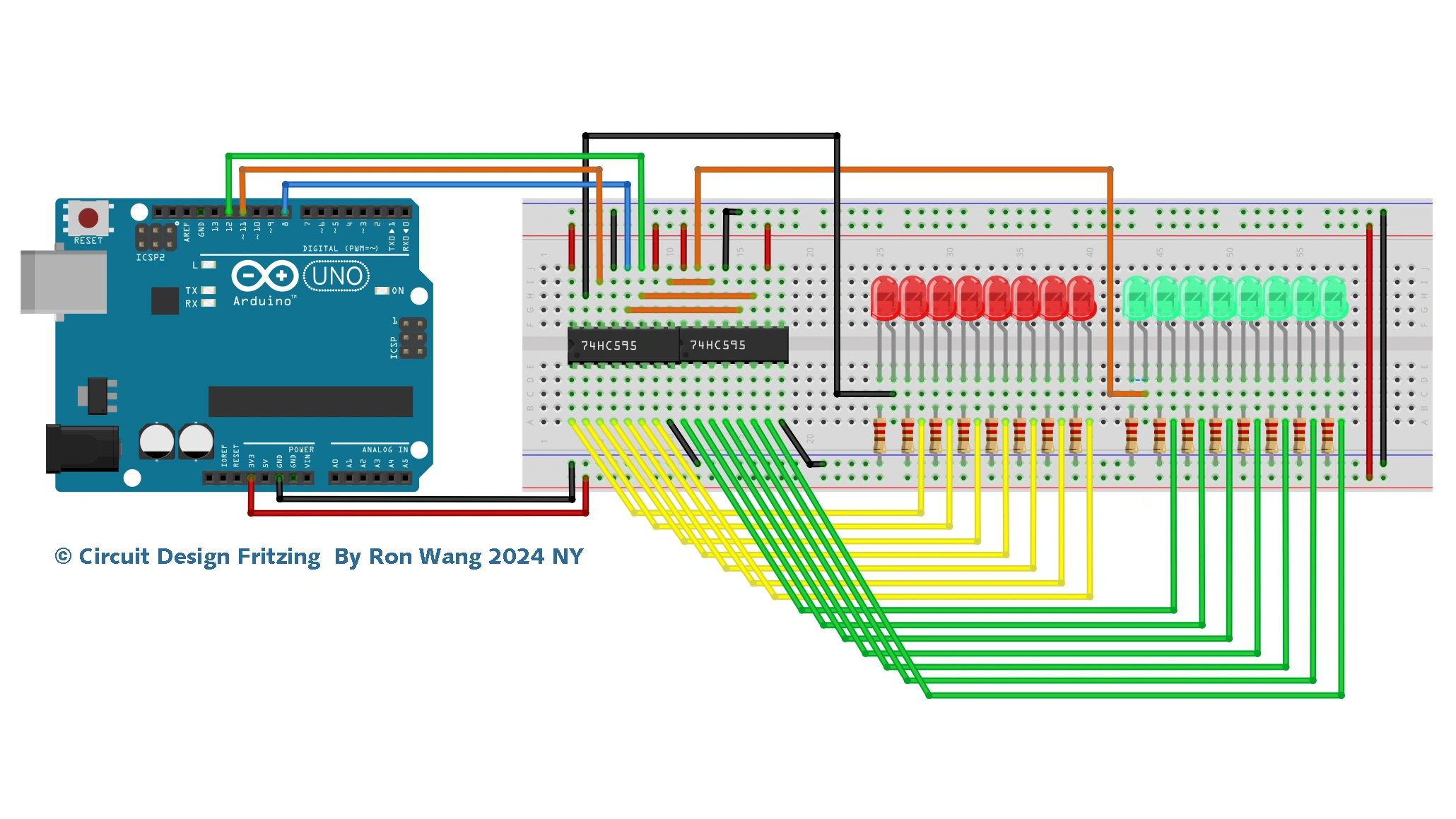
In Project 18, you will daisy chain (or cascade) another 74HC595 IC onto the one used in Project 17 to create a dual binary counter.
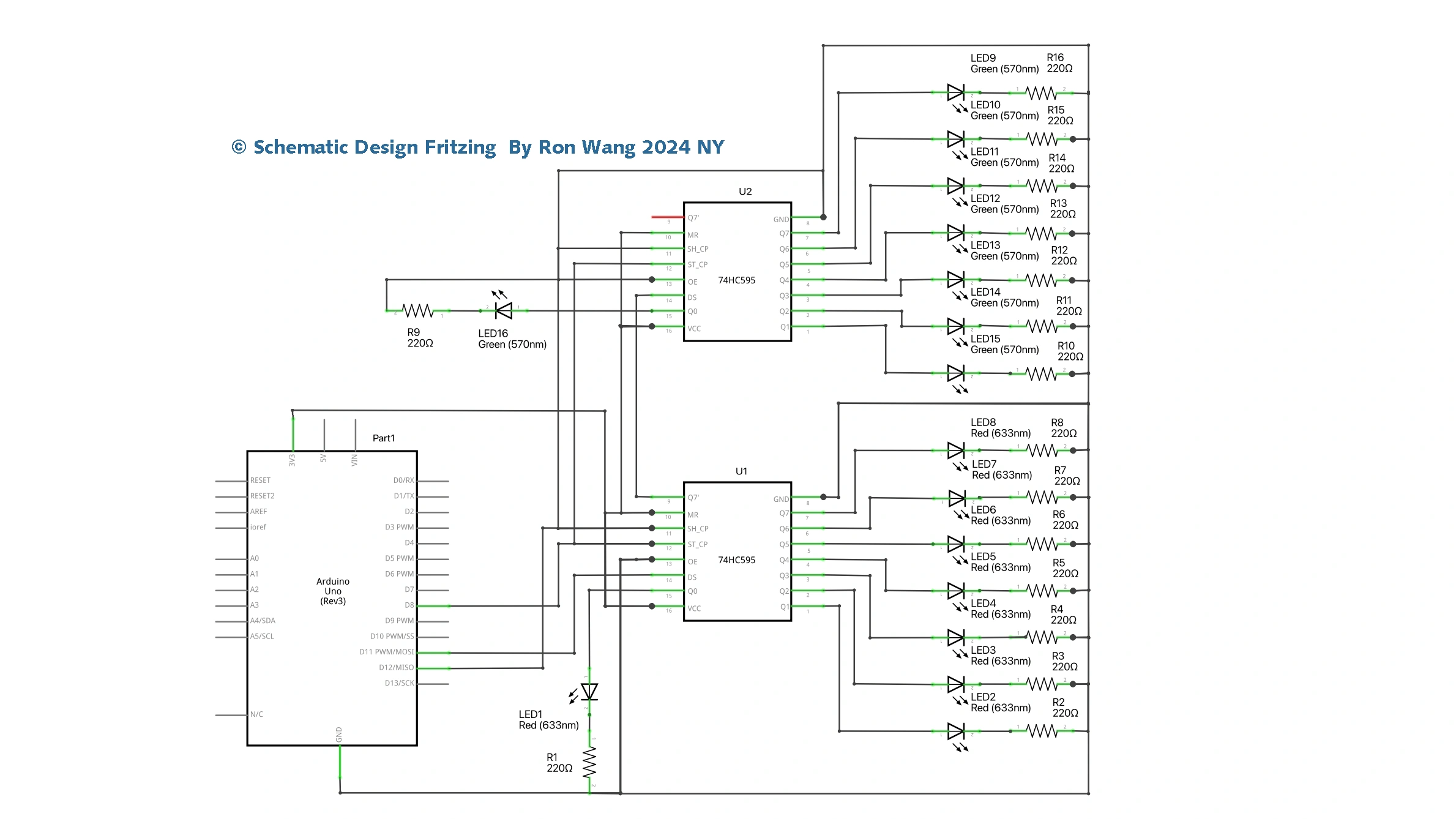
The first 595 is wired the same as in Project 15.7 The second 595 has +5V and Ground wires going to the same pins as on the first 595. Then, add a wire from Pin 9 on IC 1 to Pin 14 on IC 2. Add another from Pin
11 on IC 1 to Pin 11 on IC 2, and Pin 12 on IC 1 to Pin 12 on IC 2.
The same outputs as on the first 595 going to the first set of LEDs go from the second IC to the second set of LEDs.
项目 Project 18 Dual 8-Bit Binary Counters
/* Coding Ron Wang
   Sep.17th 2024
   Autaba support for coding hardware
   Project 18 Dual 8-Bit Binary Counters
 */
int latchPin = 8; //Pin connected to Pin 12 of 74HC595 (Latch)
int clockPin = 12; //Pin connected to Pin 11 of 74HC595 (Clock)
int dataPin = 11; //Pin connected to Pin 14 of 74HC595 (Data)
void setup() {
 //set pins to output
 pinMode(latchPin, OUTPUT);
 pinMode(clockPin, OUTPUT);
 pinMode(dataPin, OUTPUT);
}
void loop() {
 for (int i = 0; i < 256; i++) { //count from 0 to 255
 digitalWrite(latchPin, LOW); //set latchPin low to allow data flow
 shiftOut(i);
 shiftOut(255-i);
 //set latchPin to high to lock and send data
 digitalWrite(latchPin, HIGH);
 delay(250 );
 }
}
void shiftOut(byte dataOut) {
 boolean pinState; // Shift out 8 bits LSB first, on rising edge of clock
 digitalWrite(dataPin, LOW); //clear shift register ready for sending data
 digitalWrite(clockPin, LOW);
 for (int i=0; i<=7; i++) { // for each bit in dataOut send out a bit
 digitalWrite(clockPin, LOW); //set clockPin to LOW prior to sending bit
// if value of DataOut and (logical AND) a bitmask are true, set pinState to 1 (HIGH)
 if ( dataOut & (1<<i) ) {
 pinState = HIGH;
 }
 else {
 pinState = LOW;
 }
 //sets dataPin to HIGH or LOW depending on pinState
 digitalWrite(dataPin, pinState);
 digitalWrite(clockPin, HIGH); //send bit out on rising edge of clock
 digitalWrite(dataPin, LOW);
 }
 digitalWrite(clockPin, LOW); //stop shifting
}