SAE J2601:2020 General Fueling Protocol Description 05
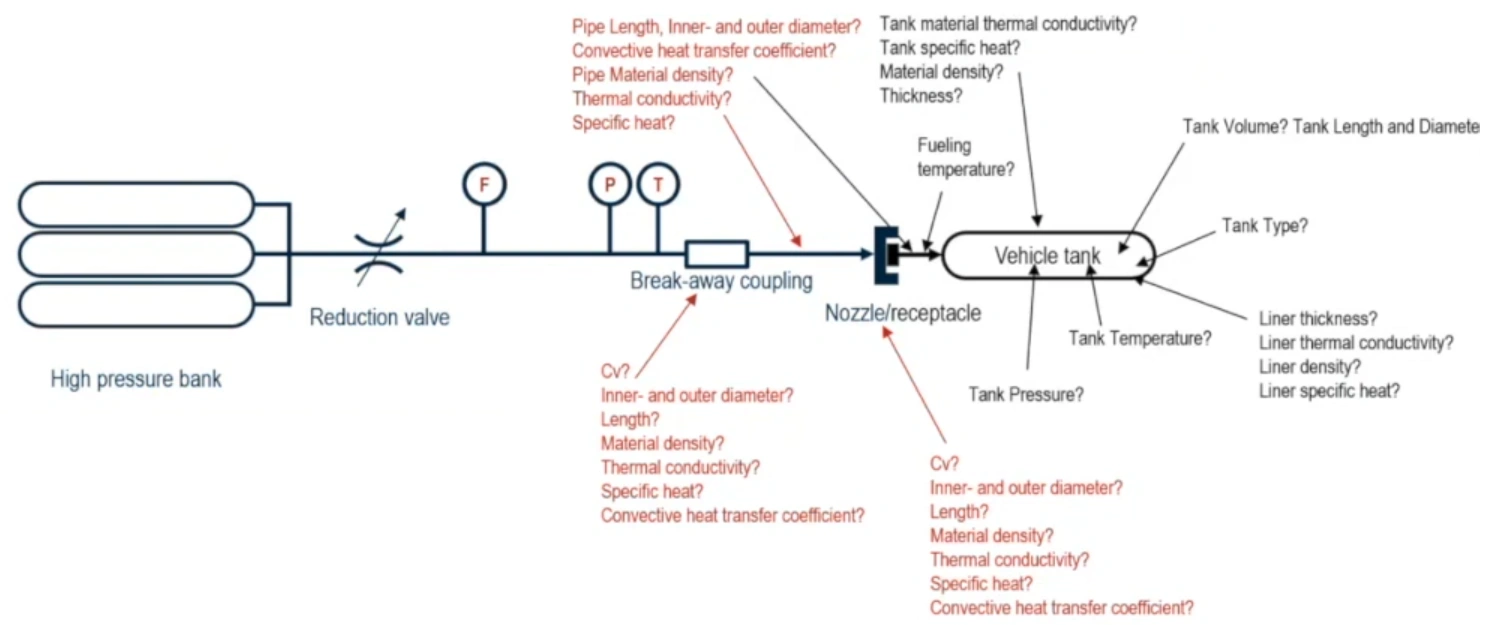
SAE J2601 establishes a gaseous hydrogen fueling protocol for hydrogen surface vehicles with CHSS capacities between 49.7 L and 248.6 L (H35 and H70) and above 248.6 L (H70 only) and a maximum flow rate of 60 g/s. The standard assumes that a station will perform fueling from its high pressure storage into the vehicle after successful vehicle connection and completion of initial checks. The fueling station is responsible for controlling the fueling process within the operating boundaries described below. Variables that affect the fueling process include, but are not limited to:
• Ambient temperature
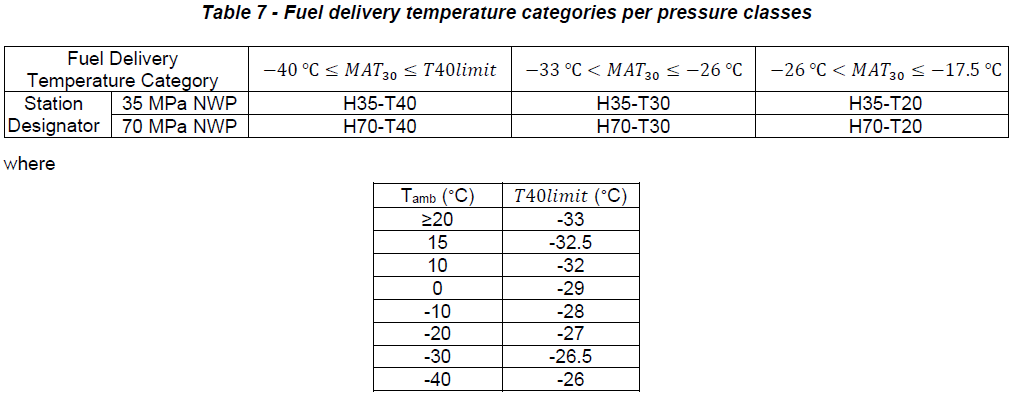
• Dispenser pressure class and fuel delivery temperature
• CHSS size, shape, material properties, starting temperature, and pressure
• Dispenser to vehicle pressure drop and heat transfer
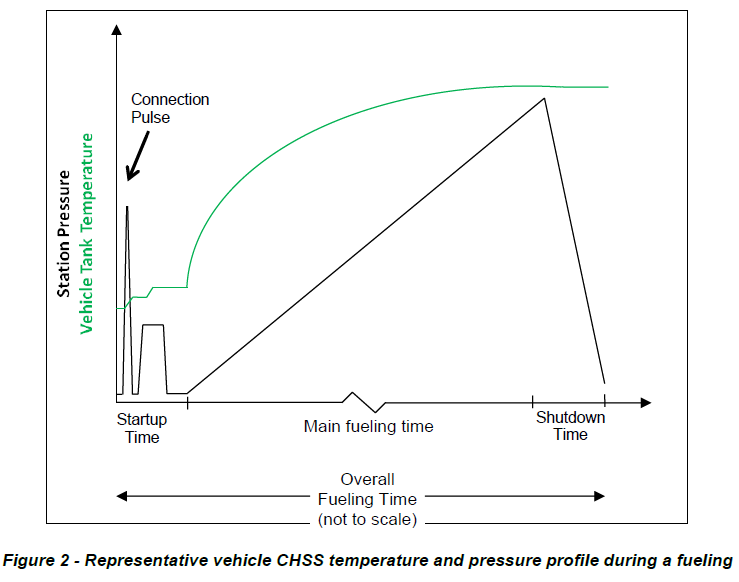
A representative fueling profile is shown below in Figure 2. The profile consists of a startup time which begins when the nozzle is connected to the vehicle and includes a connection pressure pulse. During the startup time, the station measures the initial CHSS pressure and CHSS capacity category and may also check for leaks. The main fueling begins when gas starts flowing into the vehicle. During this period, the pressure rises and the temperature of the CHSS increases. The fueling protocol should be designed such that the CHSS does not exceed the maximum operating temperature at any point during the fill. The final stage is the shutdown, which occurs after hydrogen gas has stopped flowing and ends when the nozzle can be disconnected.
5.1 Performance Goals
In general, the goal of SAE J2601 is to provide a high density fueling as fast as possible while staying within the process limits. The state of charge target when fueling with communications is 95 to 100% SOC under all operating conditions.
The fueling time can vary widely depending on ambient temperature, initial CHSS pressure, size of CHSS, final SOC, and other conditions. In order to establish a fueling time goal, the SAE team agreed to define the parameters of a “reference” fueling:
• Communications fueling tables
• Dispenser category = H70-T40
• Ambient temperature = 20 °C
• Initial CHSS pressure = 10 MPa
• Final SOC = 95%
Under these “reference” conditions, the goal of the fueling protocols in SAE J2601 is that the main fueling time is 3 minutes or less.
5.2 Normal Operating Boundaries
The fueling protocols in SAE J2601 are designed to ensure the hydrogen gas in the CHSS does not operate outside of the normal operating boundaries which are defined by the process requirements listed in Section 6. These limits include the CHSS maximum temperature and MOP.
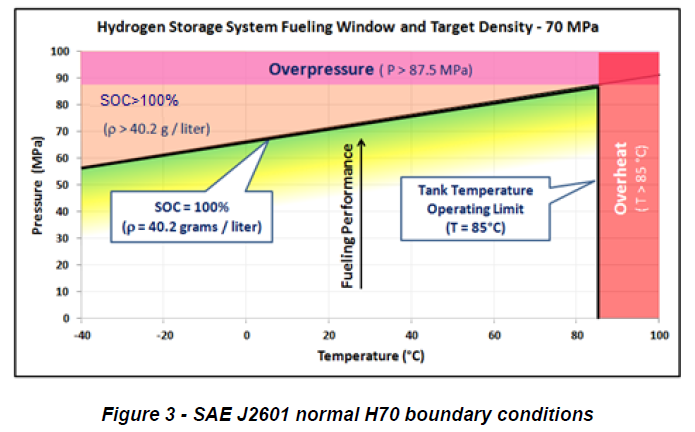
For a H70 CHSS, these temperature and pressure limits are -40 to 85 °C and 0.5 to 87.5 MPa, respectively. Figure 3 shows the boundaries for a H70 fueling. The maximum CHSS gas temperature and MOP are fixed limits at the right (overheat) and top (overpressure) portions of the graph. The maximum density (100% SOC) provides an additional boundary.
SAE J2601 normal H70 boundary conditions
In order to keep the CHSS within its operating boundaries (i.e., Figure 3), the station must adjust the flow of the gas depending on the full set of initial conditions. For example, if a vehicle is fueled on a hot day, the initial CHSS temperature may be warmer, so the station must fuel more slowly to ensure the CHSS does not exceed the maximum vehicle CHSS operating temperature.
For more details on maximum operating limits for normal and fault operation boundaries, see F.2.
Downloaded from SAE International by Univ of Toronto, Sunday, August 16, 2020
5.3 Standard Protocol
A Standard Protocol is defined as a protocol which:
• Complies with the general fueling protocol description of Section 5; and
• Complies with the general process requirements in Section 6; and
• Takes into account both the station and vehicle CHSS assumptions defined in Section 7 and Appendix A; and
• Has demonstrated the ability to keep the CHSS within its operation boundary limits under all conceivable operating conditions via computer modeling and bench testing; and
• Has been tested and validated in the field at representative real world hydrogen stations; and
• Has been reviewed and approved by the SAE Fuel Cell Standards Committee Interface Task Force.
The table-based protocol described in Section 8 and the MC Formula-based protocol described in Section 9 each meet the definition of a standard protocol, and therefore, either protocol may be utilized in satisfying the requirements of SAE J2601.
It is recommended that standard protocols and any non-standard protocols not be offered in the same station in order to minimize any risk of CHSS overheating in a subsequent fueling.